The Manusmriti, one of the oldest Dharmashastra of Hindu tradition, isn’t just about law and society it also contains deep insights into creation, time, and cosmic cycles.
But beyond legal and moral principles, the Manusmriti also offers cosmological insights touching on creation, time, the structure of the universe, and cycles of existence.
Concepts from Manusmriti Related to Cosmology:
 Cyclic Time (Kalachakra):
The Manusmriti describes time not as linear, but cyclical — involving Yugas, Kalpas, and Manvantaras.
Age of the Earth:
Some interpretations of Hindu cosmology suggest the Earth’s age in billions of years — shockingly close to modern estimates (~4.5 billion years).
Multiverse Ideas:
Manusmriti and related Vedic texts hint at multiple worlds or realms — which resonates with today’s multiverse theory in quantum physics.
Thoughts: Science or symbolism
Rather than seeing the Manusmriti as purely religious or legalistic, these cosmological references show that ancient India was deeply concerned with the origin, structure, and fate of the universe.
It may not be science in the modern, empirical sense but it reflects a profound attempt to understand reality, rooted in observation, intuition, and symbolic thinking.
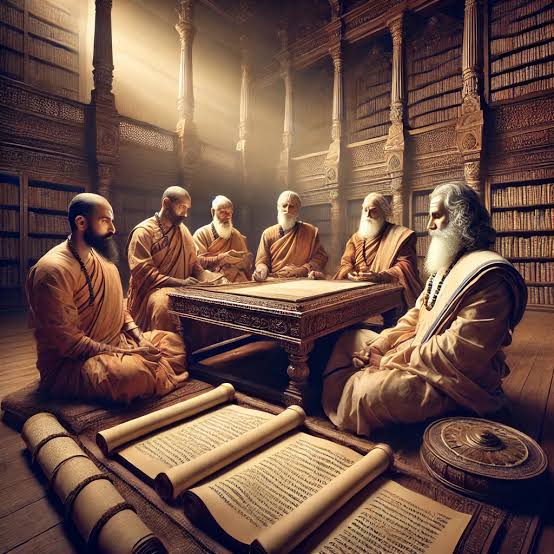
Could ancient cosmology inspire modern physics and philosophy in unexpected ways?