Most people believe they can sleep less during the week and recover on weekends.
Physiology disagrees.
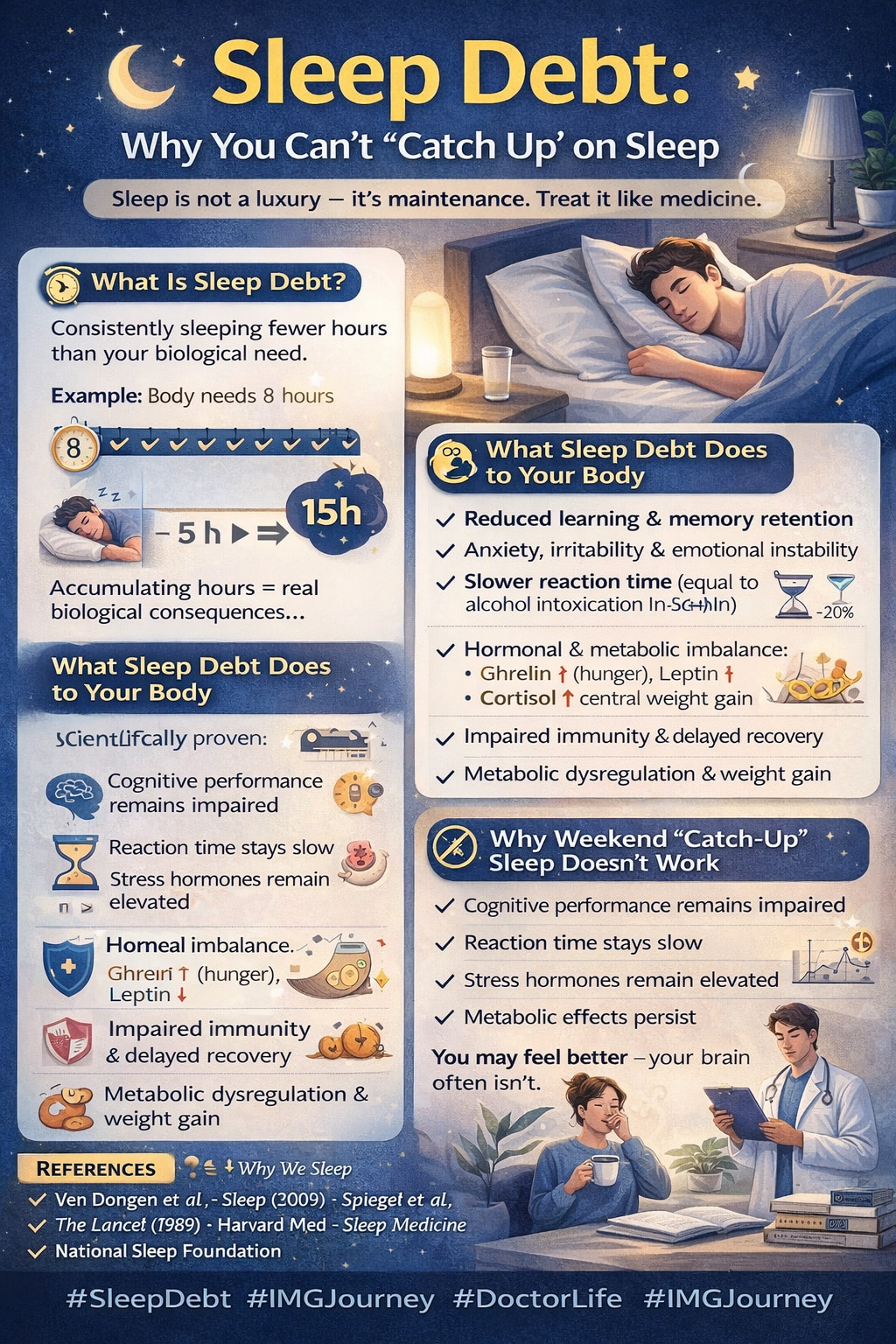
Sleep debt is the cumulative loss of sleep that occurs when you consistently get fewer hours than your biological requirement.
If your body needs 8 hours but you sleep 5, you accumulate 3 hours of debt.
Repeat this over days → real biological consequences.
What Sleep Debt Does (Evidence-Based)
Even mild sleep restriction leads to:
 Reduced learning, memory & attention
 Anxiety, irritability & emotional instability
 Slower reaction time (comparable to alcohol intoxication)
 Hormonal imbalance → ↑ ghrelin, ↓ leptin, ↑ cortisol
 Impaired immunity & delayed recovery
 Metabolic dysregulation & central weight gain
Why Weekend “Catch-Up” Sleep Doesn’t Work
Extra sleep may reduce sleepiness, but studies show:
 Cognitive performance remains impaired
Reaction time stays slow
Stress hormones remain elevated
Metabolic effects persist
You may feel better — your brain often isn’t.
You can’t outsmart physiology.
How Long Does Recovery Take?
• 1 poor night: 1–2 days to feel normal
• Chronic sleep debt: 1–2 weeks for partial recovery
• Severe long-term debt: months to restore higher cognition
Sleep recovery is not linear — deeper brain regions recover last.
Fixing Sleep Debt (Medical, Practical)
Fixed sleep–wake times
Bedroom temp 20–22°C
No screens 1 hour before bed
Light dinner, low sugar
Avoid caffeine after 2 PM
Morning sunlight (10–15 min)
Magnesium glycinate 200–400 mg (if appropriate)
Final Thought
“Sleep is not a luxury — it’s maintenance. Treat it like medicine.”
For medical students, IMGs, doctors, and patients alike — sleep is performance, health, and safety.
References
• Walker M. Why We Sleep
• Van Dongen et al. Sleep, 2003
• Spiegel et al. The Lancet, 1999
• Harvard Medical School – Sleep Medicine
• National Sleep Foundation MBH/PS