Dosage forms are classified based on their physical state and route of administration into four major types: solid, liquid, semi-solid, and gaseous.
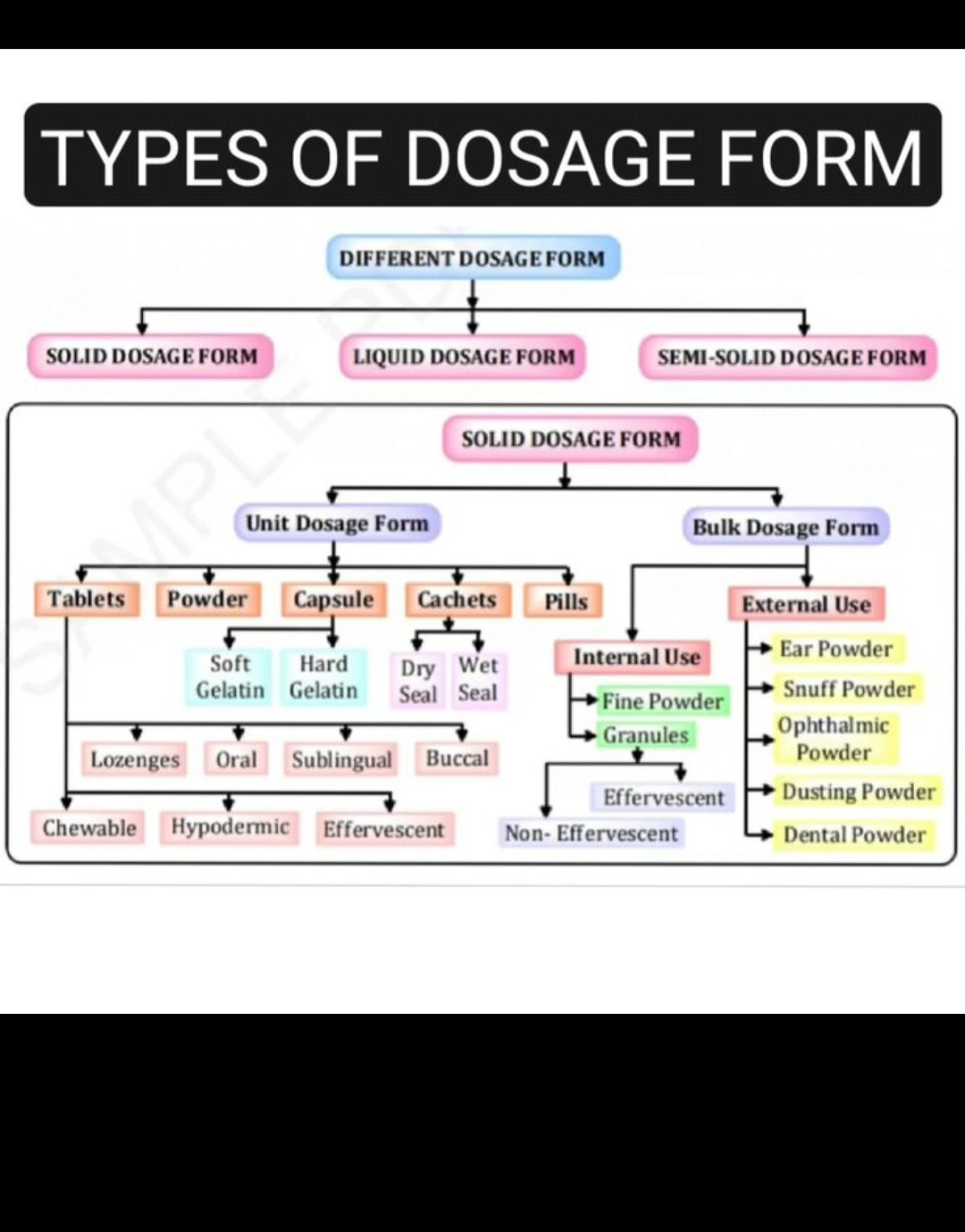
Solid Dosage Forms
Solid forms include unit dosage forms like tablets and capsules as well as bulk forms such as powders and granules. They are convenient for accurate dosing, stable, and commonly administered orally. Examples: tablets, capsules, pills, lozenges, powders, granules, suppositories .
Liquid Dosage Forms
Liquids are formulations where the drug is dissolved or suspended in a liquid medium. These include solutions, syrups, elixirs, emulsions, suspensions, drops, and mouthwashes. They can be for oral, topical, or other routes and are useful especially for patients who have trouble swallowing solids .
Semi-Solid Dosage Forms
Semi-solids are dosage forms with a consistency between solid and liquid, used mostly for topical applications. These include creams, ointments, gels, pastes, and lotions, often designed for localized drug delivery on the skin or mucous membranes .
Gaseous Dosage Forms
These are formulations administered via the respiratory tract, including aerosols, inhalations, and sprays. They deliver drugs through inhalation for local or systemic effects .
Additional Classifications
The United States Pharmacopeia (USP) categorizes dosage forms into five groups: parenteral (injections and implants), oral, topical and transdermal, mucosal, and inhalation/nasal products, focusing on the different routes and absorption pathways
MBH/PS